Target audience analysis: Fitters, business travellers & teams
Workers’ accommodation is aimed at a clearly defined target group whose needs are very different from those of typical hotel guests or holidaymakers. To market accommodation successfully and maximise occupancy, it is important to understand who books these properties, for what reasons and at what times. Only by knowing your target audience can you tailor your offering accordingly, provide the right facilities and offer suitable booking terms.
The main target groups for workers’ accommodation can be divided into three broad categories: traditional fitters and tradespeople, business travellers, and teams and project groups. Each of these groups has specific requirements, different lengths of stay and distinct booking patterns.
Fitters and tradespeople: the core target group
Fitters and tradespeople are the largest and most important target group for accommodation for fitters. They are on the move for installation, maintenance, repair or construction projects and need affordable, practical accommodation close to their place of work.
Typical applications and sectors
The group of fitters is diverse and encompasses various trades. Electricians, plumbers, heating engineers and drywall installers are frequently out on site. Mechanical engineers who install or maintain complex systems are also part of this group. In the energy sector, technicians work on wind turbines, solar farms or power stations. The automotive industry sends specialists to suppliers or production facilities.
These professionals often work shifts or have long working days. They arrive at their accommodation exhausted and, above all, need peace and quiet, a comfortable place to sleep and the chance to prepare their own meals without any hassle.
Booking patterns and length of stay
Fitters usually book accommodation for medium to long periods. Stays typically range from two weeks to several months, depending on the duration of the project. Bookings are often made through the employer or by the fitter themselves, who then requires an invoice for their accounts.
What fitters can expect
Fitters have clear expectations regarding their accommodation:
- Affordability: Budgets are usually limited, so competitive prices are crucial
- Cleanliness: A clean, well-maintained accommodation is a basic requirement
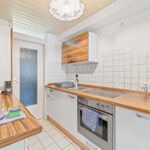
- A functional kitchen: it must be possible to cook for yourself in order to save money
- Good beds: After physical work, a good night’s sleep is important
- Wi-Fi: keeping in touch with family and accessing work documents
- Car park: Company cars and tools must be able to be parked securely
There are few requirements in terms of design or amenities. A sturdy, clean staff room with basic facilities is perfectly adequate.
Business travellers: higher expectations, shorter stays
The second key target group is business travellers. This includes field staff, consultants, sales representatives and project managers who travel for work, but who do not work on construction sites; instead, they work in offices or at clients’ premises.
Differences from traditional installation
Business travellers often have higher expectations when it comes to comfort and facilities. They need not only a place to sleep, but also a workspace, as they often have to reply to emails or write reports in the evenings.
Stays are often shorter than those of tradespeople. Typically, they last from a few days up to two weeks. However, some business travellers find themselves in the same place time and again over a period of months and therefore look for permanent accommodation.
Accommodation requirements
Business travellers value professionalism and a higher standard. A private bathroom is often a must; a shared shower is usually out of the question for this group.
The following features are particularly important:
- A desk and a good Wi-Fi connection: essential for working in the evening
- Quiet location: ideal for focused work and a restful night’s sleep
- En-suite bathroom: privacy is more important than it is for tradespeople
- Professional service: prompt communication, clear invoicing
- Good transport links: easy access to appointments
Although price is a factor, it is less of a deciding factor than it is for tradespeople. Business travellers are willing to pay a little more if the facilities are up to standard.
Teams and project groups: Housed together
The third major target group consists of teams and project groups. These are groups of people who are working together on a project and are therefore looking for shared accommodation. They might be installation teams setting up a system, or construction workers on a major project.
Advantages of shared accommodation
For businesses, it is often more practical and cost-effective to accommodate an entire team together rather than booking several single rooms. Staff can chat after work, cook together and strengthen team spirit.
Teams usually book entire flats or several rooms in a single property. The length of stay can range from a few weeks to several months. For large construction projects, accommodation is sometimes even rented for a year or longer.
Special requirements for group bookings
Teams need plenty of space – both in the bedrooms and in the communal areas. A large kitchen with enough seating is important so that the team can eat together and chat.
Flexibility regarding check-in and check-out is important. Team members often arrive or depart at different times. A straightforward key handover is an advantage in this situation.
When booking for teams, companies often prefer framework agreements with fixed terms and conditions. This simplifies the booking process and provides planning certainty.
Seasonal fluctuations and booking periods
Demand for accommodation for construction workers is subject to certain seasonal fluctuations, although overall it is more stable than demand for tourist accommodation.
Peak season in spring and summer
Demand tends to be higher in spring and summer, as this is when most construction projects are underway. When the weather is good, people are building, renovating and installing new systems. Maintenance work on outdoor facilities also tends to take place during the warmer months. During this period, accommodation for construction workers is often fully booked.
Winter und ruhigere Phasen
During the winter months, demand sometimes falls, particularly in the construction sector. Some work cannot be carried out in frosty conditions. However, there are also sectors that operate all year round – such as manufacturing or mechanical engineering.
Business travellers are on the move all year round, and their bookings are not subject to significant seasonal fluctuations. They can help fill capacity gaps during the winter months.
Booking channels and approach
Different target groups use different methods to find accommodation. Tradespeople often search via specialist portals for tradespeople’s accommodation or via Google. Business travellers sometimes use traditional hotel booking sites or book directly through company contacts. It is important for landlords to have a presence on the right channels. Having your own website with clear information on facilities, prices and booking options is essential. The approach should be honest and transparent – clear photos, precise descriptions and fair prices are more important than glossy advertising. Those who know their target group and address them accordingly will be rewarded with high occupancy rates.