Quality standards for apartment furnishings
The facilities provided in a workers’ accommodation play a key role in determining whether guests are satisfied, return, and recommend the accommodation to others. Whilst hotels have clear standards that are communicated through star ratings, such uniform quality criteria are often lacking in workers’ accommodation. Nevertheless, certain minimum standards have become established within the industry that good workers’ accommodation should meet. Landlords who consistently implement these standards stand out from the competition and achieve higher occupancy rates.
This article provides a comprehensive overview of the key quality standards for workers’ accommodation and flats. From basic facilities and technical details to the little extras that make all the difference – here you’ll find practical recommendations for comfortable accommodation.
Basic fittings: The foundation of every tradesman’s flat
Before you start thinking about special extras, the basic facilities must be in order. These basic elements are not optional extras, but essential requirements for acceptable workers’ accommodation.
Sleeping area and beds
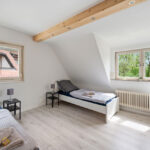
The sleeping area is the heart of any accommodation for construction workers. After a hard day’s work, a good night’s sleep is essential. Only single beds measuring at least 90×200 cm should be provided. Double beds are unsuitable for this group, as nobody wants to share a bed with a colleague.
Mattresses must be of good quality and have a medium firmness. Sagging or overly soft mattresses can lead to back problems and poor sleep. As a general rule, mattresses should not be more than five years old and should be checked regularly for wear and tear. Sturdy bed frames that do not squeak or wobble are just as important as mattress protectors for hygiene.
Fresh bed linen on arrival is a given. Duvets should be appropriate for the season, and two pillows per person ensure individual comfort. Bed linen should be changed at least every two weeks.
The ability to block out light is often underestimated. Curtains or blinds that can truly darken the room are particularly important for shift workers. A reading lamp by the bed and a central ceiling light with sufficient brightness complete the lighting setup.
Storage space and furnishings
Guests staying for weeks or months need enough space for their personal belongings. A wardrobe with at least 60 cm of width per person is the minimum requirement. There should be a sufficient number of hangers – at least ten per person.
A chest of drawers or a shelf for laundry makes a useful addition to the wardrobe. A bedside table next to the bed provides space for a mobile phone, an alarm clock and personal items. A mirror of a suitable size is essential – ideally a full-length mirror.
The furniture must be functional and sturdy. Wobbly cupboards or doors that hang crookedly look unprofessional. Chairs or seating to accommodate the number of people are also part of the basic equipment.
The kitchen: the heart of self-sufficiency
A fully equipped kitchen is essential for fitters, as most of them cook for themselves to save money. The kitchen equipment must therefore not only be available, but also functional and complete.
Electrical appliances and technical equipment
The hob is the most important part of the kitchen. A hob with at least four hotplates allows you to cook several dishes at the same time. Ceramic or induction hobs are now the norm. The oven must be in working order, even if it is used less frequently.
The fridge must be suitable for the number of people living there. A smaller model is sufficient for two people, whereas for four or more residents, a larger fridge with a decent-sized freezer compartment is recommended. Microwaves, coffee machines and kettles are now standard. More important than the number of appliances is that all the appliances provided actually work.
Cookware, crockery and cutlery
The kitchen must be fully equipped with cookware. There should be at least two pots of different sizes and two frying pans. In addition, there should be sharp knives, chopping boards, wooden spoons, spatulas and bowls.
Crockery and cutlery should be plentiful:
- Crockery: flat and deep plates for all residents plus spares, a sufficient number of cups and glasses, bowls and serving dishes
- Cutlery: a full set of knives, forks, spoons and teaspoons, plus a wooden spoon and a spatula, a tin opener and a corkscrew
- Cleaning: washing-up liquid, sponges and dishcloths, tea towels and oven gloves, bin with bin liners
The kitchen should be equipped in such a way that the washing-up does not need to be done immediately after every meal. A dishwasher is a big plus, but not essential.
Kitchen worktop and dining area
It is important to have enough worktop space for food preparation. A kitchen that is too small, with barely any room for chopping, makes cooking a nightmare. A dining table with enough chairs is a basic necessity. This is not just where meals are eaten, but also where people often work or simply sit together.
Bathrooms and sanitary facilities
The bathroom must be clean, practical and equipped with everything you need. Hygiene is the top priority here.
Shower, toilet and washbasin area
A properly working shower with good water pressure is essential. After a day on the building site, you want to be able to have a proper shower. There must be plenty of hot water available, even if several people are showering one after the other.
The shower tray must be clean and free of mould. Mould in the grouting is absolutely unacceptable. The toilet must be in perfect condition, and there should be toilet paper available on arrival.
The washbasin needs a mirror, soap and sufficient shelf space for toiletries. Hooks for towels and clothes are handy. Towels are provided for all residents and should be changed regularly during longer stays.
Washing machine and laundry care
A washing machine is essential for stays of a week or more. It may be located in the flat or in a communal laundry room. The important thing is that it works and is accessible. Providing washing powder for the first wash is a nice touch.
A clothes horse or tumble dryer must be provided. An ironing board and iron are particularly important for business travellers, but tradespeople also appreciate being able to iron their clothes.
Technical features and comfort
Modern technology is now standard. Fast Wi-Fi with a speed of at least 50 Mbps is essential. The signal must be stable in all rooms. The password should be clearly displayed or available via a QR code.
A television is standard equipment. The screen size should be appropriate for the room, and the remote control must work. A smart TV with access to streaming services is a bonus.
The heating must work in all rooms and should be individually controllable in each room. In summer, it is important to be able to ventilate the property; air conditioning is a major advantage in hot regions or in top-floor flats.
Cleanliness and maintenance
Even the best facilities are of no use if the accommodation isn’t clean and well-maintained. The flat must be spotlessly clean on arrival. All floors must be mopped and vacuumed, the kitchen and bathroom thoroughly cleaned, and the windows clean. Bed linen and towels must be freshly laundered, and the bins emptied.
Quality must be maintained throughout the stay. For long-term stays, a cleaning service should be provided every two weeks. Any faults must be rectified quickly – if something breaks, guests expect a solution within 24 hours.
Quality standards are not a one-off project, but require ongoing maintenance and attention. Those who are consistent in this regard will be rewarded with satisfied guests, positive reviews and high occupancy rates.